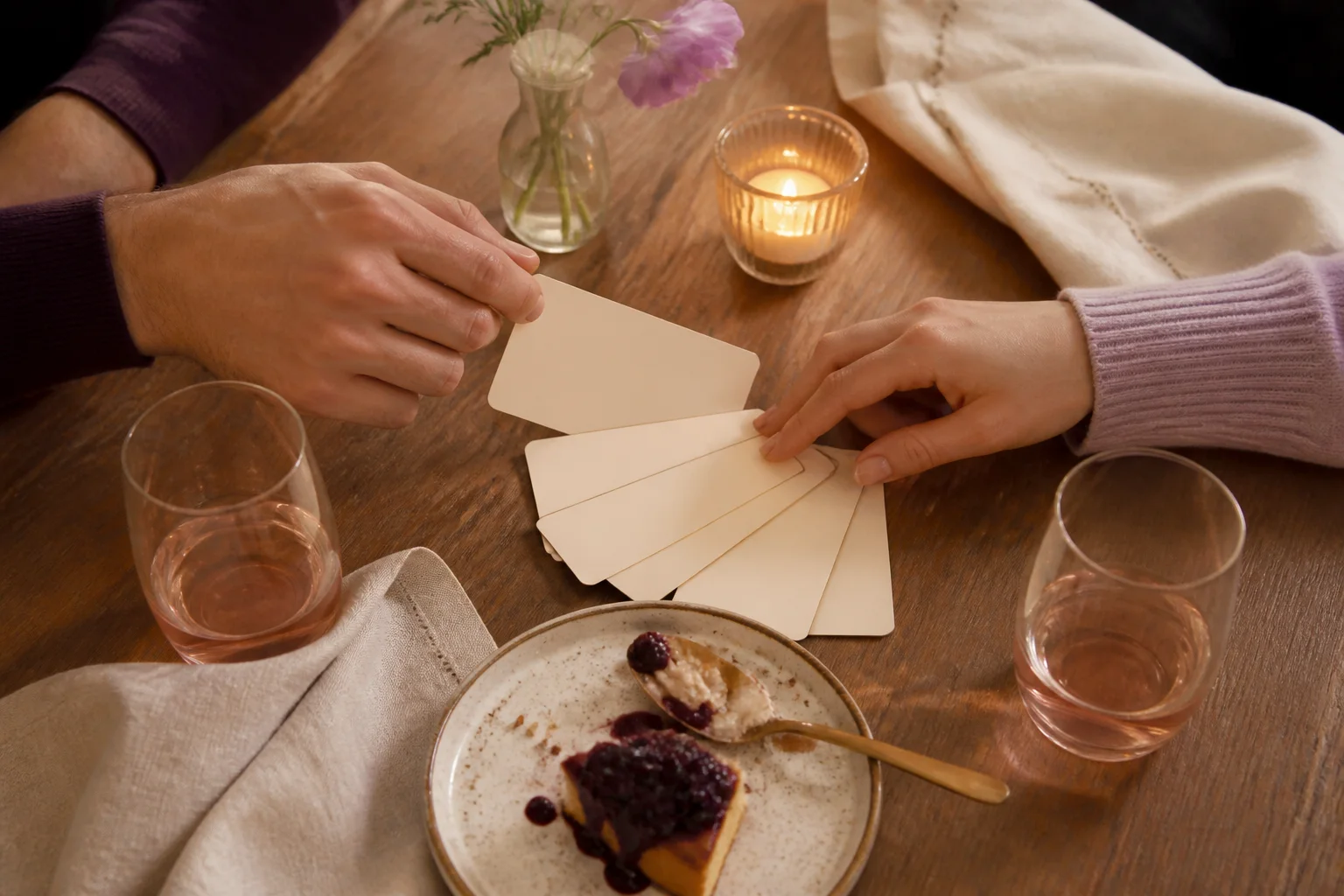

Answer the same question without seeing each other’s reply. Reveal both answers only when both people are ready, then discuss the difference instead of grading the match.
Separate answers let each person form a reply before seeing the other’s. You can use paper, two private notes, or messages sent at an agreed time.
When a separate reveal is useful
This format suits questions where the first answer could steer the second. It works well for preferences, shared memories, plans, and guesses about what matters to each person. The point is to hear two answers that formed independently, even when they match.
Choose a direct conversation for an urgent decision or immediate reassurance; waiting for a reveal can make either harder. If the subject involves harm or safety, stop the game format and seek appropriate support.
Before starting, agree that either person can change the question, keep an answer private, or stop after the reveal. Consent to play one round does not commit either person to every follow-up.
How to run a separate reveal
- Choose one question together.
- Each person writes an answer privately. Agree on a rough length, such as three sentences.
- Either person can pass or ask for a different question.
- When both answers are ready, swap phones, turn over the paper, or paste both replies into the chat.
- Each person asks one curious follow-up. Do not score how similar the answers are.
For different time zones, send “ready” without sending the answer. Reveal when both people are awake and have enough time to read without rushing.
Keep the answers similar in scale. If one person writes a sentence and the other writes a page, the reveal can feel uneven before the conversation begins. A limit such as three sentences or five minutes of writing gives both people the same starting point.
A complete example round
Suppose you choose: “What would make next week easier for us?” One person writes, “Deciding on our Saturday call before work gets busy.” The other writes, “Having one evening where neither of us needs to solve anything.”
Those answers do not conflict. One asks for certainty and the other asks for rest. Useful follow-ups would be “Which evening needs protecting?” and “Would choosing Saturday now remove some pressure?” After both people explain, you might choose Saturday now and leave one evening unscheduled.
Avoid jumping straight to a compromise. Read both answers once, let each person explain, then decide whether the question needs an action at all.
Choose a question for the energy you have
| If you want to… | Start with… |
|---|---|
| Notice something good | 1, 2, 6, 7, or 12 |
| Make the next week easier | 3, 13, 14, or 17 |
| Revisit a shared story | 4, 9, 15, or 16 |
| Talk about support or conflict | 5, 10, or 11 |
| Look further ahead | 8 or 16 |
Pick a lighter question when either person is tired. A question is not better just because it asks for more vulnerability.
Seventeen questions for the format
1. Which ordinary moment makes you feel closest to me?
Name a specific scene rather than a general trait. The answers may reveal two very different kinds of closeness.
2. What do you think we handle well as a pair?
Choose something observable, such as planning, recovering from a bad day, hosting people, or making each other laugh.
3. What would make next week easier for us?
Keep the answer small enough to act on. A clearer plan or one protected hour is more useful than a complete life redesign.
4. Which shared memory would you like to relive for one hour?
Say which hour and what you would notice this time.
5. What kind of support is easiest for you to receive from me?
Examples can include listening, practical help, reassurance, space, food, or help making a decision.
6. Which part of our current routine should we protect?
Pick something that could disappear when work, travel, or family demands change.
7. What have you learned about me recently?
The answer can be small. A new preference or reaction is often more useful than a sweeping insight.
8. What do you hope feels different for us six months from now?
Describe the difference in ordinary life. Avoid treating the answer as a promise until you discuss what it would require.
9. Which place feels most like ours?
It can be a city, room, bench, route, or recurring online space. Explain what made it shared.
10. What helps a difficult conversation feel fair to you?
Name the conditions you can control, such as timing, tone, breaks, one topic at a time, or a clear next step.
11. What is one thing you want me to ask about more often?
Choose a part of life that tends to disappear behind daily logistics.
12. What small gesture from me has stayed with you?
Name the exact gesture so your partner knows what you appreciated and may want to do again.
13. What should we do when one person has less energy for the relationship routine?
Agree on a low-energy version that does not punish either person.
14. Which decision would you like us to make together soon?
State the decision before arguing for an outcome. Use the reveal to see whether the same issue is on both minds.
15. What does a good visit or weekend together include for you?
Mention pace, plans, rest, people, and alone time if they matter.
16. What do you want us to remember about this period of our lives?
The answer can hold what is difficult as well as what is good.
17. What is one realistic promise we could make for the next month?
Choose something that survives a busy week and can be discussed without blame if it changes.
When the answers are different
Different answers give you something to ask about. Ask “What makes that important to you?” or “What would that look like in a normal week?” Listen for the kind of difference before trying to resolve it:
- Two preferences may both fit, such as wanting a planned call and an unplanned voice note.
- Two memories can differ because each person noticed another part of the same day.
- Two needs may require a practical choice about time, money, travel, or effort.
- One answer may introduce a subject that deserves a separate conversation.
If one answer surprises you, repeat what you think you heard and let your partner correct it. “I heard that you want more notice before we make weekend plans. Is that right?” is easier to answer than a guess about why they feel that way.
Some answers need time. Either person can say, “I want to think before I respond,” choose when to return, and end the round there. If an answer feels painful, pause the game format and talk directly. The reveal rule should never trap either person in a conversation they are not ready to have.
What to do after the reveal
Most rounds need only one follow-up from each person. If the answers point to a shared preference, save the idea for later. If they expose a practical problem, write one next step and decide who owns it. When the question produced a good story, let the story be the ending.
Do not turn old answers into evidence in a later disagreement. People revise plans and understand themselves differently over time. Treat each answer as what the person wanted to say in that moment.
For lighter prompts, use the fun couple questions. For questions matched to a particular season, use the relationship questions by stage.
A note about Adoring
Disclosure: The Adoring team wrote this guide. Adoring is still coming soon for iPhone and is not publicly available. Its planned daily questions for couples use the same private-answer and shared-reveal format described above.
Written by
Adoring editorial team
Practical guides from the team building Adoring, reviewed against the current product, repository, and cited source material.